Free Translation:
Rav Tachlifa says, it is fitting to proceed with women first at the receiving of Torah. The reason
for this stems from the fact that connection to Hashem comes through the commandments. The man is
better fit for this connection. The woman is more physical and her level is not as high as is the man’s.
Therefore Adam HaRishon was commanded first since he was closer to Hashem. The woman’s greater
distance from Hashem led to her initiation of the first sin and destruction upon the world. Because her
connection is lacking, she caused sin which greater damaged the connection. The first man’s connection
was also not complete as was Israel’s at the receiving of Torah. They received a complete connection.
Since the connection at Gan Eden was not complete, therefore the man went first and afterward the
woman.
But Israel received a complete connection when Torah was given to them. This is demonstrated
by the case of Adam who received only a portion of the commandments and therefore his connection was
incomplete. Because of the complete connection established at the receiving of Torah, it was safe to
approach the women first. The women are not at a level as high as are the men, but the connection at
Sinai was complete. Afterwards the man was commanded, his connection and his level are higher than
that of the women. Therefore the command of the women preceded the men. The receiving of Torah by
the women shows that this reception of all of Israel was complete. And this complete reception is a
greater thing. Therefore she is mentioned first.
Explanation:
Commandments solidify the connection of people to Hashem. However, a person must be
equipped to handle the connection. Only a portion of commandments were given in Gan Eden, so the
connection of man to Hashem made at that time was incomplete. Since Adam was naturally better
connected to Hashem than was Chava, he was better able to constructively manage the incomplete
connection made at that time. Chava’s initiation of the first sin is proof that her connection was lacking
something that Adam’s did not lack. At Har Sinai, a full set of commandments was given and therefore a
complete connection to Hashem was being formed. Under such conditions, the danger of giving Torah to
women first was satisfactorily eliminated. The women are still at a lower spiritual level than are the men,
but there was no danger at Har Sinai of their being at a lower level leading to destruction.
With the danger eliminated, it was better to approach the women first for various other reasons.
These reasons include their enthusiasm for commandments, to encourage them to lead their children in
the ways of Torah, and to emphasize to them their reward for enabling their husband’s Torah learning.
The enthusiasm of women mentioned in the first reason is an individual personality trait. It is not a
comprehensive desire for commandments, but rather an initial desire. The Radal explains that this
enthusiasm wears off when obstacles to the commandments appear (Radal on Midrash Rabbah, Shemos
28:2:4). The third reason relates to a fear that the women would prevent their husbands from accepting
Torah since the women may not see what gain they have from Torah since only men are commanded to
learn it. Speaking to the women first was a way of demonstrating to them their equal share in their
husband’s reward for learning.
Literal Translation:
Rav Tachlifa says, it is fitting to proceed with women first. And this is because the decree and the
command from Hashem, may He be blessed, to man who receives it, is the covenant and the connection
of Hashem to man, who received the decree. And this is explained in many places. And since the man is
more fitting to the covenant and the connection with Hashem, may He be blessed, since the woman is
more physical, and the level of the woman is not like that of the man, therefore, the man was commanded
first since his level was close to Hashem, may He be blessed. And because of this, the woman destroyed
since the connection of the woman to Hashem, may He be blessed, is not like that of the man. Behold,
her connection is lacking. And since the connection is lacking, it came from this destruction that damages
the connection. And this thing is specifically by the man who did not receive the complete connection
like all of Israel who received a complete connection. Therefore with regard to the man was the
connection according to his level, the man went first and the woman after. All is according to the level of
the person.
Rather, Israel received a complete connection when Torah was given to them. And the proof of
this is that Adam HaRishon received only a portion of the commandments and therefore the connection
was not complete but Israel, since the Torah given to them was compete, their connection to Hashem was
complete. Therefore it is fitting for the woman to be commanded first at the receiving of Torah since this
thing was a complete connection. The woman is not at such a level when she received the decree but it
was a complete connection. And afterwards the man was commanded his connection and his level are
greater than that of the woman. Therefore the command of the woman preceded the man. The receiving
of Torah by the woman shows this that the reception of all of Israel was complete. And this is a greater
thing. Therefore she is mentioned first.
Saturday, January 25, 2014

Wednesday, January 15, 2014
A Letter from HaRav HaGaon Moshe Feinstein zt’l about Feminism
A Letter from HaRav HaGaon Moshe Feinstein zt’l about Feminism
Literal translation of a letter written by HaRav HaGoan Moshe
Feinstein zt"l concerning feminism and the exemption of women from
positive time bound commandments. (Igros Moshe, Orach Chaim IV #49)
(The letter is addressed to a Rav in Boston
Regarding the distinguished (Jewish) ladies who are fighting
along with women of the nations of the world in their (social) movement. These
(Jewish) ladies are observant of Torah and want to bring their fight to matters
of relevance to Jewish law. Some (of these ladies) pray with tallaisim and so on. They seek my view
in this matter and how the rabbi of the shul should handle the matter.
Firstly, you must know that it is an essential matter of faith in our
Torah that the written and oral Torah was given by The Holy One Himself at Mount Sinai through Moshe Rabbanu, o"h. It is
impossible to change even one point (of the Torah) whether to be more strict or
to be more lenient. But we were commanded that when there is a time to
establish precautionary measures, it is incumbent on the Sanhedrin and the
sages of the Torah to do so, by prohibiting certain things. They also may
obligate others. They (the sages) must make it very clear that these are
rabbinical obligations. Since our dispersion to foreign lands, we lack the
power (to make such enactments). However, the wise men of every region (have the power) to make
enactments only for their region and only for a short time.
In view of this, the exemption of women from positive time bound
commandments is a (decree) of the Torah. Also, the Rabbis never obligated women (in these commandments)
since there is no reason to do so. Indeed, there is a reason to exempt women from these commandments specifically for the
reasons that the Torah exempts them.
And besides the reasons for the Torah which are unknown to
regular people and to the great scholars, and we are required to believe that
there are great reasons of Hashem who gave the Torah, (besides this), there are
(non-ultimate) reasons revealed to everyone. (In the matter of the
exemption of women from positive time bound mitzvahs) the average woman is not
wealthy and has responsibility to raise sons and daughters. This (task) is most
important work for Hashem and His Torah and so Hashem made each species so that
the woman should raise the offspring. Humans are no exception. The nature of
women enables them to raise children. Along those lines, it (the burden) was
made easier on the women by not requiring them to learn Torah and to perform positive time
bound mitzvahs.
(However) even if the order of the world were to change and all women were wealthy all the time and it were possible to give
over the children to men and women (to raise them as is done) in our country,
the Torah's law cannot change and neither can that of the Rabbis. It is useless to
fight this. Even with the agreement of the entire world, there is no power to
change (the Torah) one iota. The women who stubbornly wage war to make such changes are committing
heresy.
The Rambam, in chapter three, law number eight, of the Laws on
Repentance,
says
the following: "Three (people) are called heretics: The one who denies
even one word spoken by Moshe Rabbainu, the one who denies the explanation of
the oral Torah, and the one who switches one word (of Torah) for another. These are heretics
and their judgment shall be a forfeiture of their place in the next world.” According to
the words of the Rambam, to say that the Creator switches around commandments
and all the more so that men can switch around the commandments -- is to say that the Torah is not eternal.
And the whole reason (it is called heresy) is that they are rebelling against many verses which teach us
of the eternity of the Torah, and so writes the Kesef Mishnah.
Women are permitted to perform (certain) commandments for which
they are not obligated and receive divine reward for such performance. And also according to the view of Tosfos, (women) are
permitted to make a blessing (on such commandments) as is our custom. (It is our custom also for women to be permitted) to fulfill the
commandments of shofar and luluv and to make blessings (on these). Therefore,
concerning tzittzit, a woman who wants can dress in a garment not designed for
men, as long as this garment has four corners to it, and attach tzittzit to fulfill this
commandment.
Concerning the wearing of tfellin, Tosfos writes in Eruvin 96, divray hamaskil: myachal, that (this
commandment) should not be performed (by women). Tfellin requires tremendous care to keep the body in (halachic) cleanliness and to focus one's attention. For this reason
even men who are obligated in tfellin limit their wearing (of tfellin) from all day to
during morning prayers. The Rema holds similarly (Choshen Mishpat, 98:3). Targum Yonason, on the verse: "There should not be a man's clothing on a woman" (holds) that
(women should not wear) tzitzit or tfellin since they are garments of men. Tosfos does not
believe there to be such a Targum Yonason. This (performance of non-obligatory commandments by a woman) applies only if her soul yearns to perform the commandment even though she is not commanded. (It is another matter) if her intention is to protest
against the Holy One and His
Torah. Such a posture is not congruent with the performance of a commandment. Indeed, it is a forbidden act and an act of apostasy. Since (such a woman) is trying to amend Torah law.
You should know that all of this (the exemption of women from positive time bound commandments) is not because women are on a lower level of holiness than are men. While obligation in commandments results strictly from one's having holiness, men and women, in that sense, are equal in holiness. All the verses in the Torah regarding holiness refer also to women. (This applies from) the beginning (with) the arrangement to receive the Torah (at Sinai). "You'll be to me a treasure and you'll be to me a holy nation." Exodus 19:6. (The subject of this verse is all of the nation of Israel Israel
(The references to men and women of all verses regarding
holiness extends also after Sinai with) "You'll be for me a people of holiness," parshas Mishpatim, "you'll be
holy," parshas Shimini, "holy you'll be and you'll be holy," parshas Kedoshim, and "and a
nation of holy people you are to Hashem" parshas Re’eh. Women also (as well
as men) are referred to in every mention of holiness.
Therefore women also include in their blessings the words
"you have sanctified us with your commandments." (Women do
this) even when performing commandments for which they are not obligated. (The exclusion of women from positive time bound commandments) is a leniency made by Hashem for his own reasons and not because of any diminution (regarding the women) Heaven forbid. We explained this earlier.
And concerning the obligations between husband and wife, a husband is obligated to treat his wife with respect and a wife is obligated to treat her husband with respect. (Furthermore) many women were prophetesses and subject to the same laws concerning prophets as were the men (prophets). In many matters, women were praised more than the men by the (written) Torah and by the Rabbis. There is no denigration in their (women's) respect in their exemption from the learning of Torah and positive time-bound
commandments. There is no reason to have any gripes.
The distinguished rabbi (of the congregation in question) should
explain this every time and be strong and firm in his knowledge that this is all a matter
of the Torah and he should correct these women. And after all this if (these women) still stand in their incorrect and stubborn view, (the rabbi) should not allow
a single change in the
holy customs of Israel
I end with a blessing for true peace and a good writing and sealing for a good year for the distinguished rabbi and to all that is
his, to the whole holy congregation, the men, the women, and the children.
Tuesday, January 14, 2014

Monday, January 13, 2014
Seventh Lubavitcher Rebbe, Menachem M. Schneerson on the Exemption
Explanation for the
Exemption of Women from Time-bound Commandments
The Seventh Lubavitcher
Rebbe, Menachem M. Schneerson, zt’l
Today’s portion of Rambam concerns the mitzvah to write a
Sefer Torah. The obligation to write a Sefer Torah, however, devolves only upon
men, not upon women. What connection, then, is there between this mitzvah and
women?
We shall resolve this difficulty by first explaining why in
general there are certain mitzvos which women are not obligated to carry out.
It is not because women are inferior to men. It is because G-d has given each
Jew a mission uniquely suited to the individual: A task for men and a separate
task for women – and a mission common to both men and women.
The relationship between men and women may be compared to
the workings of a person’s body. All of a person’s limbs are part of the one
body; yet each limb has a different function: the head – intellect, the heart –
emotions, etc. Thus the body has two separate – but simultaneous – dimensions.
On the one hand, all its limbs share the same life-force: the blood circulates
to all its limbs, and only when circulation in all limbs is proper is the body
healthy. Simultaneously, each limb has its own distinct character and function.
Within the body of Jewry, the same two dimensions are
operative. There are some aspects of Torah which men and women share equally.
For example, the mitzvah, “Love your fellow as yourself.” Since this mitzvah is
most important for the continuing health of Jewry – it is Jewry’s “life force”
– it devolves upon men and women equally. Similarly, the mitzvah, “to know that
there is a First Being” – knowledge, not just faith – is obligatory upon women
as upon men.
Simultaneously, there are aspects of Judaism in which men
and women differ, with special missions given to a man and others to a woman. So
that each can carry out his or her task fully, he or she is freed from other
obligations. Although these other obligations are holy matters, the full and proper
accomplishment of one’s special tasks demands that one be freed of these other
obligations.
For men to carry out their task for example, they are freed
of duties such as rearing children from birth. To this end, G-d created the
world such that a child, in his early years, needs and is dependent on this
mother specifically.
In similar fashion, women were freed of certain obligations
so that they can devote themselves fully to their unique task. A child’s
education in his early years, for example, is the mother’s responsibility, and
to this end, women are freed from the obligation to fulfill certain Mitzvos
which men are duty-bound to do. Women are thus able to devote all their
energies to their unique mission.
In the above described relationship between men and women –
that each is freed of certain duties so that they can properly carry out their
primary mission – a wonderful element is introduced. Because G-d is whole and
perfect, He implanted the trait of wholeness and perfection also in Torah and
mitzvos. Thus, although women are not obligated to perform certain mitzvos,
they can still attain the state of wholeness and perfection effected through
fulfilling these mitzvos — although they do not actually perform them! How?
Women are freed from performing
mitzvos which are obligatory only at a specific time (e.g., tzitzis, which is
obligatory only during the day). The AriZal writes concerning such mitzvos:
“When the male performs the mitzvah, it is unnecessary that the woman should
also do them separately, for she has already been included with him at the time
when he does the mitzvah ... This is the meaning of our Sages’ statement, ‘One’s
wife is as one’s body.’” Similarly, the Zohar says that a man (or woman) alone
is “half a body.”
In other words, when Torah frees
a women [sic] from certain mitzvos, it frees her only from doing them— so that
she can devote her time and energies to her unique mission. The state of
wholeness and perfection that is attained, and the reward that accrues, from
these mitzvos, does pertain to women also — through her husband performing
them.
This applies even to a girl
before she is married, through the fact that her destined partner in marriage
performs the mitzvos she is not obligated to do. For just as a man and a woman
are but “half a body” before marriage, and are whole only when married, so too
their soul is whole only when they are together: that is, a man and wife have a
single soul.
However, although destined
partners in marriage have one soul (as the soul is in the heavenly spheres), G-d’s
desire is that when that soul descends to earth it should for a time (before
marriage), be divided into two: half the soul in the boy and half in the girl.
Each fulfills its mission separately until the right time comes when G-d joins
them, and they fulfill their tasks together, fortified by the special Divine
blessing (Bereishis 1:27 -28),
“He created them male and female; and He blessed them.”
The joining of two halves of one
soul, which for years were separated from each other, sometimes even in
different lands, is the reason for the intense joy at a marriage, infinitely
greater than the joy at any other event. It is the greatest joy imaginable when
G-d, Who “sits and makes matches, assigning this man to that woman and this
woman to that man,” brings the halves of the soul together to make them again
one soul.
G-d, of course, knows even
before marriage to whom each half of a single soul belongs. Thus, when a boy
performs a mitzvah devolving on men only, his fulfillment of it counts also for
the other half of the soul which resides in his destined wife. He may not know
of it, but G-d does.
In the light of the above, we
can now understand that the mitzvah of writing a Sefer Torah applies to women
and girls, too.
Sichos in English, Iyar-Tammuz
5744, Vol. 21, pp. 69-72, N’shei Convention.
Chabad.org: Convention of N’shei Ubnos Chabad, 25th Day of Iyar, 5744 (1984)
Chabad.org: Convention of N’shei Ubnos Chabad, 25th Day of Iyar, 5744 (1984)
Thursday, October 17, 2013

Sunday, May 26, 2013
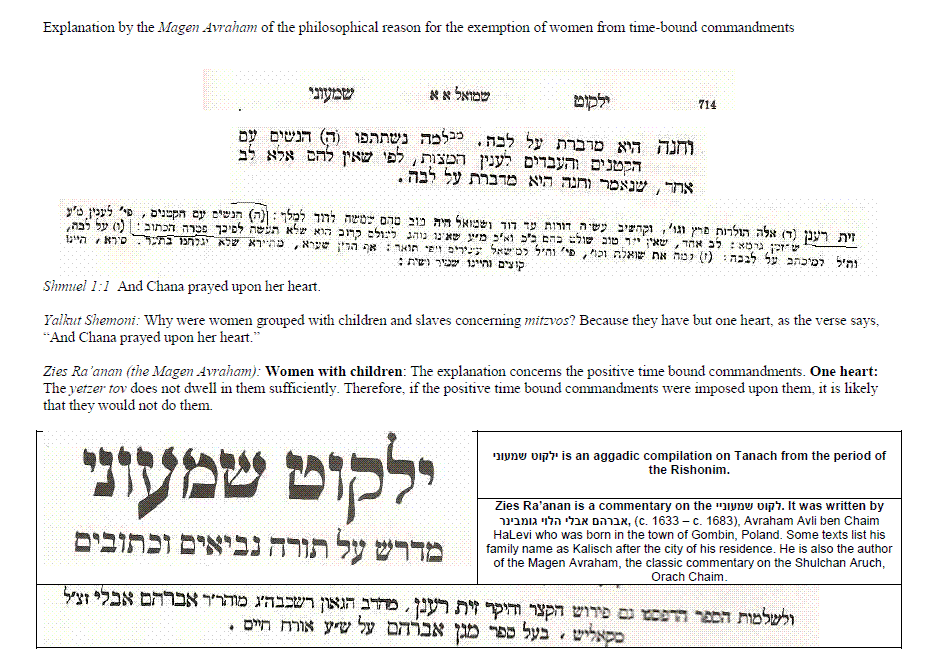
Magen Avraham
Shmuel 1:1 And Chana prayed upon her heart.
Yalkut Shemoni: Why were women grouped with children and slaves concerning mitzvos? Because they have but one heart, as the verse says, “And Chana prayed upon her heart.”
Ziies Ra’anan (the Magen Avraham): Women with children: The explanation concerns the positive time bound commandments. One heart: The yetzer tov does not dwell in them sufficiently. Therefore, if the positive time bound commandments were imposed upon them, it is likely that they would not do them.

Subscribe to:
Posts (Atom)